



01 · PERSONAS
13 advisors aligned with Conway's Law
Each AI agent is a specialist tied to a bounded context (DDD, product, business, tech). Formal scope, never autonomous decision-makers. The organization drives the AI, not the other way around.
Swoft models your expertise and your organisation, then builds the software that follows your rules. Your software shares the same data, so you stop paying for and connecting 10 different tools.
Video in French.
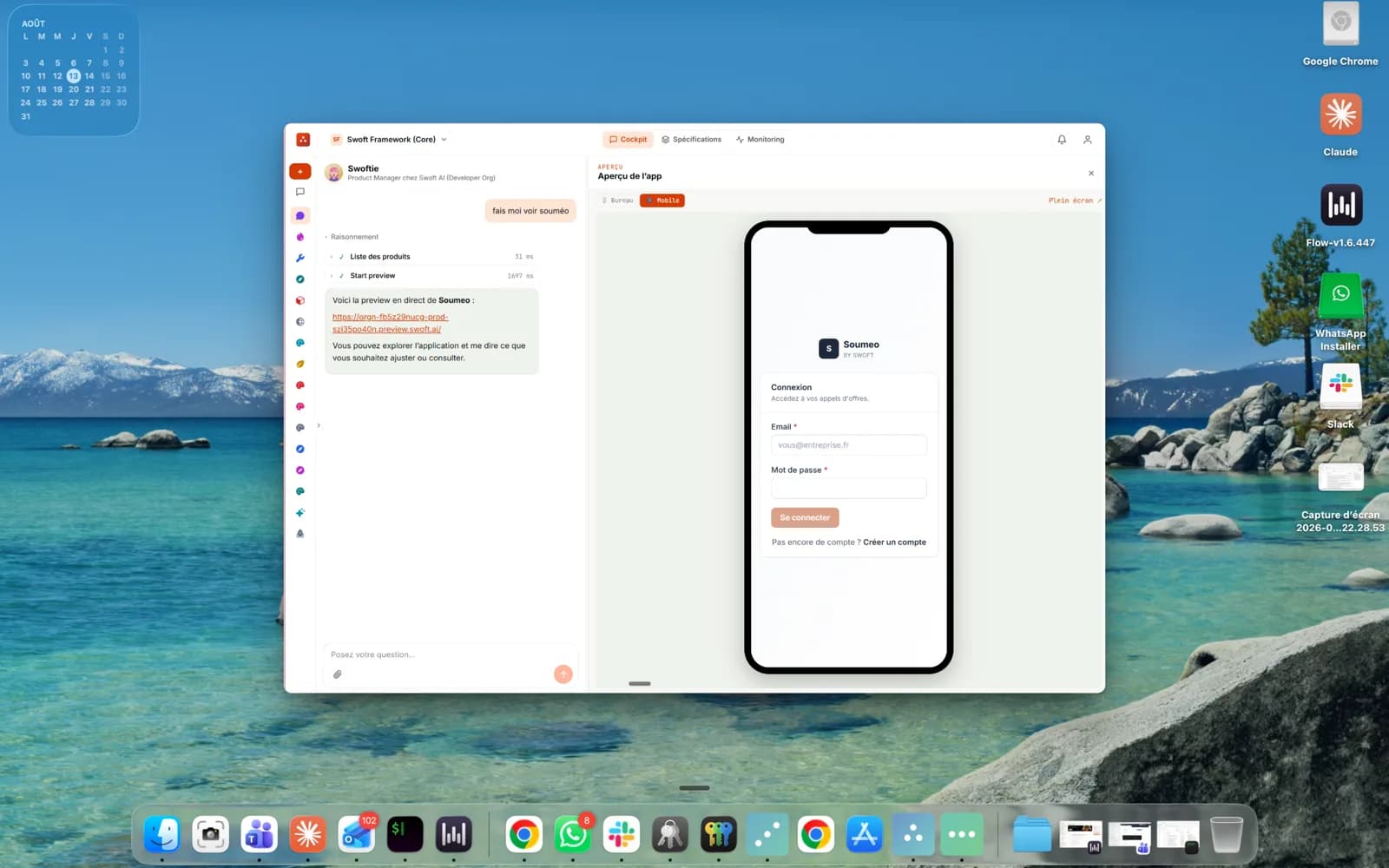
Building your product and evolving it.
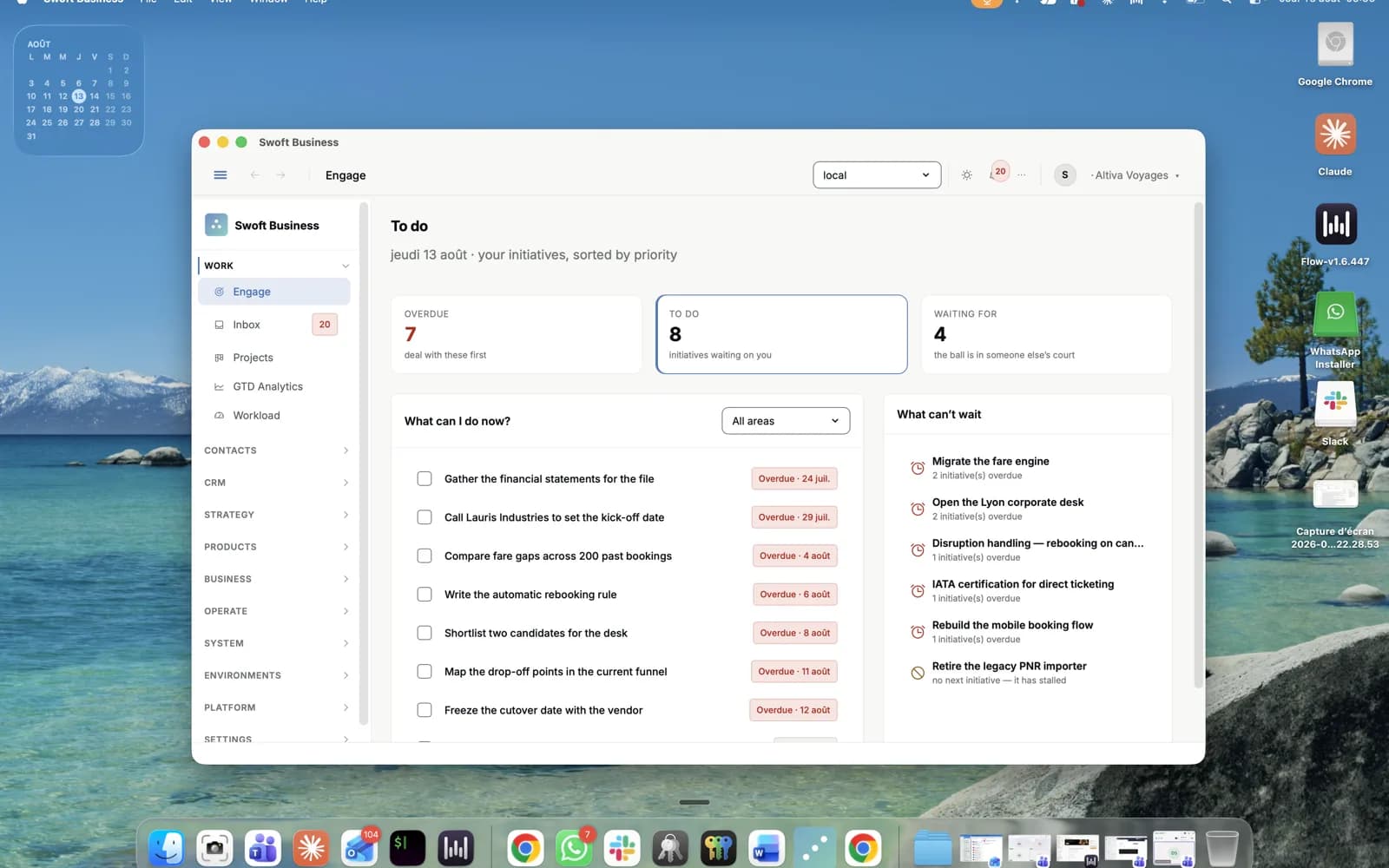
Understanding your product and running your day.
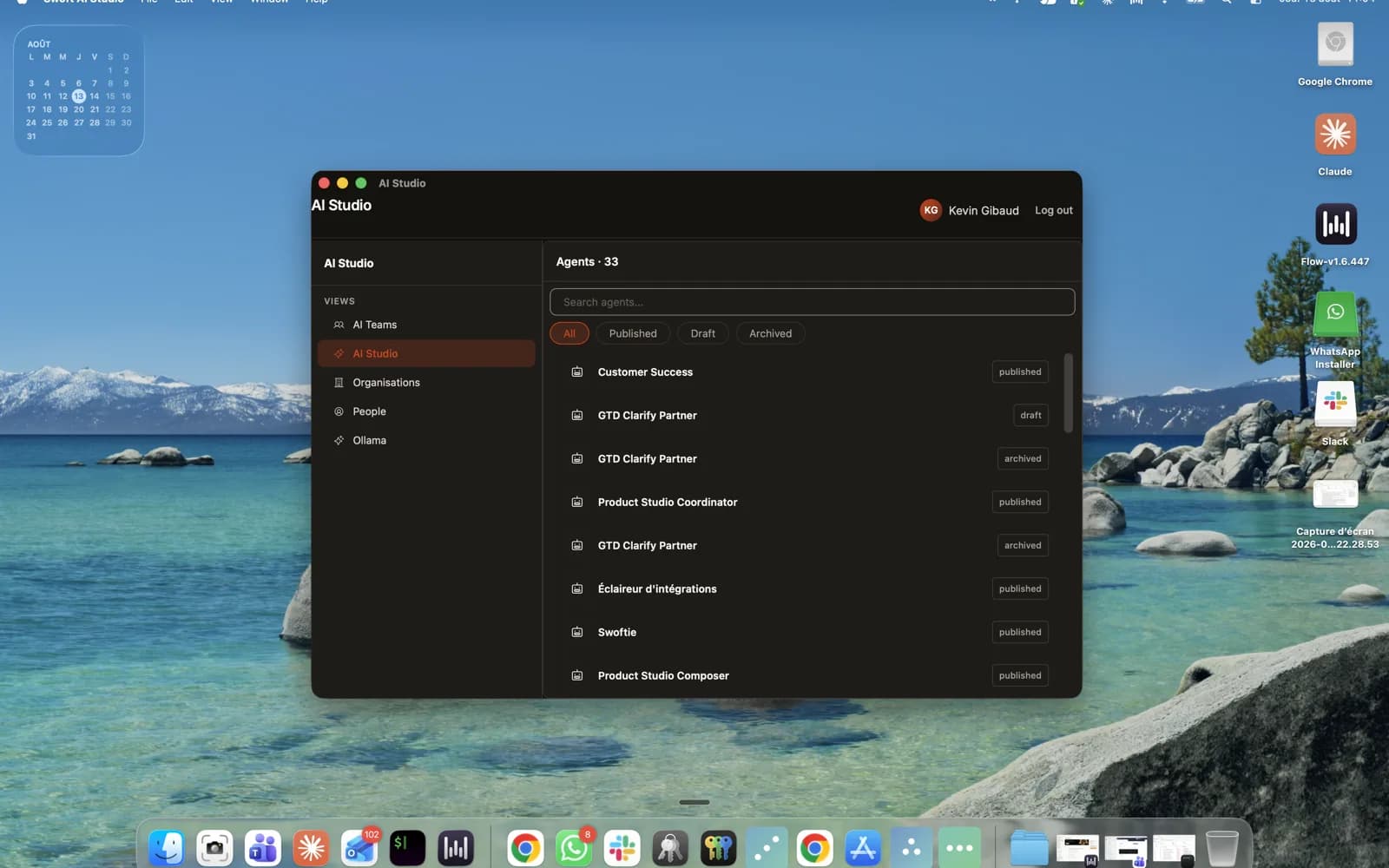
Having an AI engineer without hiring one.
| Bolt.new, Lovablegénérateurs d'app IA | Claude Codeagent de code | Freelance ou salariéune personne | Swoftorganisation autonome | |
|---|---|---|---|---|
| What you have to supply yourself | Nothing to start. A developer to pick the code up afterwards. | A team of developers. It is a tool built for them, not for you. | Recruitment, a salary or a day rate, and day-to-day management. | Nothing. |
| Who changes the software six months later | You, inside their editor. Or a developer, once the code has been taken over. | Your developers. | The same person, if they are still around. | You, by asking for it in plain words. |
| Where your software exists | Web. And mobile through Expo for Bolt. | Whatever your developers write. | Whatever they know how to build. | Web, mobile and desktop |
| How long before you are in production | A demo within hours. Production depends on who picks the code up next. | However long your developers spend on it. | Hiring time, then project time. Count in months. | A few weeks, production included. |
| AI agents inside your software | Up to you to call an AI API from the generated code. | It writes your code. It does not ship inside your software. | Whatever that person knows how to build. | Declared agents, tooled and steerable, delivered with the application. |
| What stops one change from breaking another | The tests you remember to write. | The tests your developers write. | The tests that person writes. | A model that refuses an inconsistent change before producing it. |
Humans and AI agents, same rules, same traces.
REST, MCP, real-time and CLI APIs, generated together.
Sagas, declarative rules, automatic compensation.
Everything is kept. Everything can be replayed identically.
Your domain modeled inside your system. Everything else follows.

Each AI agent is a specialist tied to a bounded context (DDD, product, business, tech). Formal scope, never autonomous decision-makers. The organization drives the AI, not the other way around.
Every AI action is an immutable event: reasoning, model, confidence score, prompt. Replay is guaranteed identical five years later, independent of the underlying model.
Every AI commit records who authorized and who executed. The metamodel blocks any drift between intent and code by construction, not by manual review.
For two years everyone has tried to put AI to work, and everyone has stopped at the same place: it drafts beautifully, then someone has to key it all in again. That ceiling isn't AI's. It belongs to the software you bolt it onto.
Then it stops. The real work starts where it ends.
Every action leaves a trace, under the name of whoever took it.
Nobody re-keyed anything, and no connector links any of it: each fact triggers the next because your whole business shares a single memory. What that ends up forming has a name: an operating system for your organisation.
Most agentic offerings hand the agent a pile of tools and a prompt, then hope. We hand it a modelled business, and four things follow that no prompt can replace.
A quote, a job, a due date: every word of your business exists in the system with a single definition, the one your teams use. The agent has nothing to guess, and two departments cannot call two different things by the same name.
We don't politely ask the agent to avoid terminating a contract that never started: the system refuses the move. A guardrail written into the model always holds; a sentence in a prompt can be talked around.
Every change is a dated, preserved fact. The agent doesn't only see where a case stands, it sees what happened to it, the difference between executing and understanding a situation.
We cut the system the way your organisation is cut: sales, operations, finance. An agent works inside one of those perimeters, a team's, not the whole company's.
Others lay a language model over existing tools. We build the world the agent works in.
This isn't an in-house method: it's Domain-Driven Design and Conway's Law, actually applied rather than name-dropped. It's the slow part, the one you can't catch up on in a quarter, and it's what makes an agent aligned with your organisation instead of bolted onto it.